

The Vastu Purusha Mandala
A cosmic figure laid across your property, and the grid that turns that figure into a practical map you can read a floor plan against.
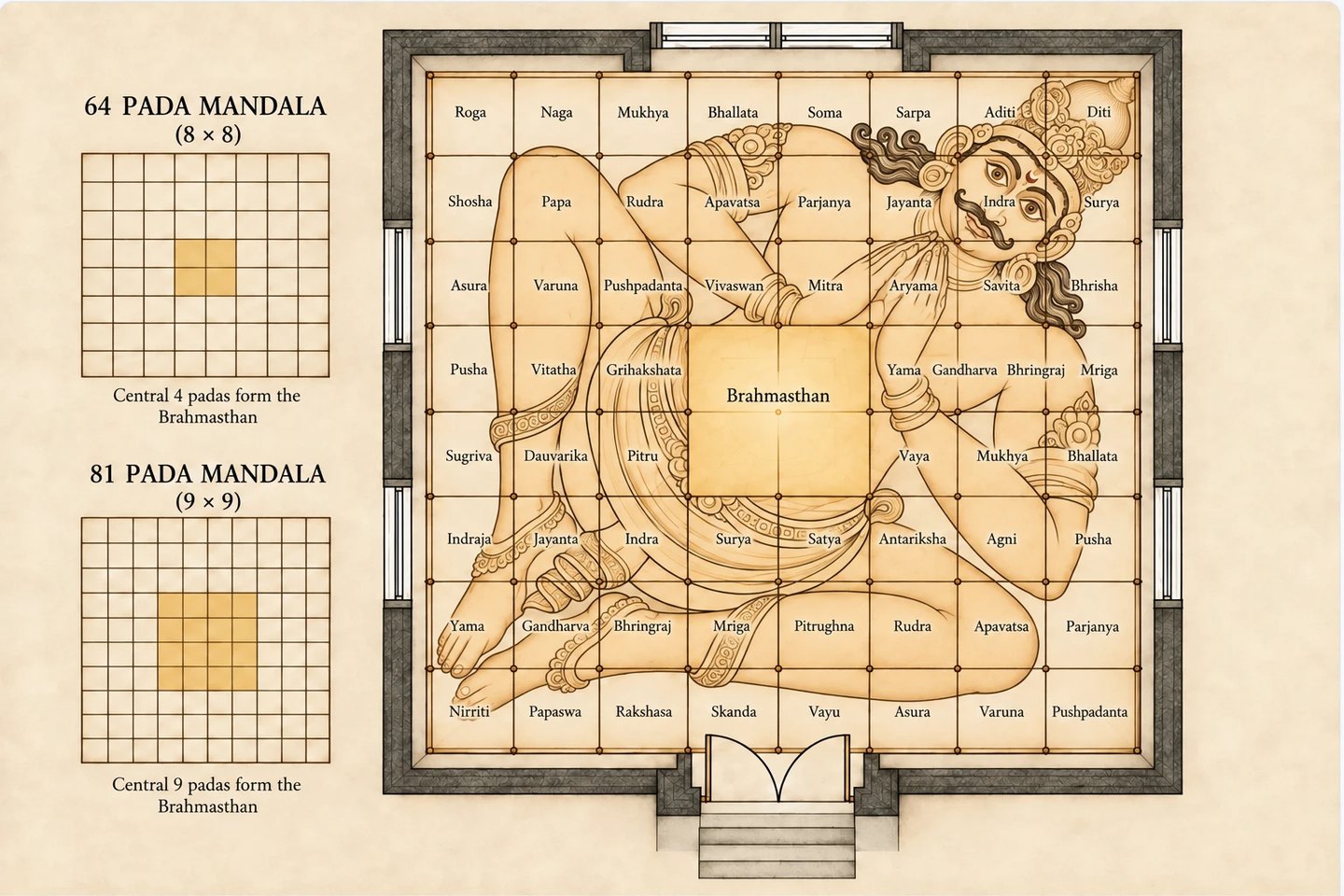
Understanding Vastu Purusha
Vastu Purusha is the cosmic being that embodies Vastu principles. Imagine a human figure lying across your property — the head faces northeast, the feet point southwest, and various body parts correspond to different zones.
This isn't literal. It's a map. The Purusha represents how cosmic energy is distributed across your space — different parts of the body govern different life areas.
The 64 Pada Mandala
The basic Vastu grid divides your property into 64 squares (8×8). Each square is a "pada," and each pada has specific qualities and a ruling deity.
Use the 64 Pada system if you want detailed analysis. It's precise and gives specific remedies for specific zones — if your entrance falls in an unfavorable pada, you can identify the exact issue and address it. Full breakdown in Padas & Devtas.
The 81 Pada Mandala
The 81 Pada system (9×9 grid) offers more granularity. Each pada gets a separate ruling planet — more detailed than the 64 system.
Use this if you want deep analysis, or if you have a large property or complex layout. For apartments and smaller spaces, the 64 Pada system usually works fine.
Brahmasthan: The Heart of Your Home
Brahmasthan is the central zone — the heart and consciousness of your space. In a 64 Pada grid, it's the 4 central squares. In an 81 Pada grid, it's the central 9 squares.
Keep Brahmasthan open. Don't place kitchen appliances, heavy furniture, or pillars here — this is where energy gathers and distributes. A cluttered Brahmasthan blocks the flow to all other zones.
How the Mandala System Works
The Mandala is a tool, not a rule book. You use it to:
- Identify which pada your entrance falls in
- Identify which pada your bedroom, kitchen, and other rooms occupy
- Determine if those placements support your life
- Get specific remedies if a placement creates imbalance
Not every property perfectly fits the Mandala. Apartments, L-shaped homes, and odd layouts require flexibility — the principles matter more than perfect grid alignment.